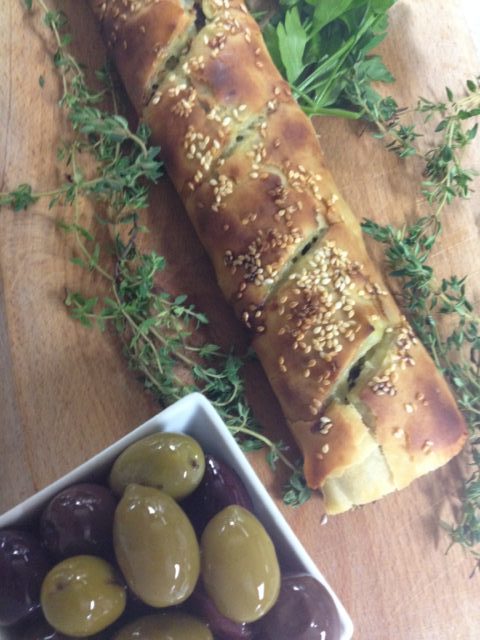
Executive Chef Gregory Zapantis, of Molos in Weehawken, shared his recipe for pumpkin bulgur and honey fillo pie. Enjoy it with family or friends!
Pumpkin Bulgur and Honey Fillo Pie
Ingredients 3 cups pumpkin puree
2 tablespoons extra virgin olive oil
1 onion, diced small
1 lb. feta cheese
2 eggs
4 oz honey
1½ tablespoons fresh mint
2 tablespoons bulgur wheat
Salt and freshly ground white pepper
1 lb fillo pastry sheets
Directions 1. Slice pumpkin into wedges and roast on in a preheated 375° oven for 50 minutes.
2. Allow the pumpkin to cool slightly and then remove the skin and the seeds.
3. Cube the pumpkin and place in a food processor to puree.
4. In a large frying pan, heat 2 tbsp. of olive oil.
5. Sauté the onion until it is soft and translucent, about 4 minutes. Remove from heat and set aside to cool.
6. In a medium bowl, combine the pumpkin puree with the crumbled feta, eggs, mint, bulgur wheat, honey and season to taste with salt and freshly ground white pepper.
7. Add the onions and mix well.
8. Preheat the oven to 350°F.
9. Lightly grease the bottom of a sheet pan with olive oil.
10. Brush a sheet of fillo well with olive oil.
11. Leaving about an inch margin on the sides and bottom of the Fillo sheet, place a thin line of filling (about 3 tbsp.) along the bottom edge.
12. Fold the sides in and begin to roll the bottom edge up to make a tube.
13. Repeat the above step to fill the sheet pan.
14. Bake the pie logs in a 350°F oven for 45 minutes, or until the fillo is golden brown.
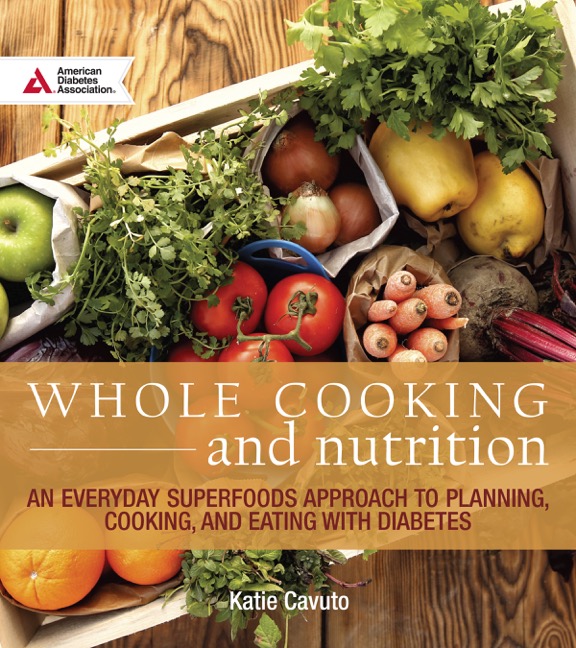
Do you prioritize food? I know what you’re thinking, “I’m reading Jersey Bites—of course I do!” But that’s not what I mean. It’s time to reacquaint yourself with actual food, the stuff that’s designed to go in your body, supporting not only your physical functions but your heart soul as well. It’s what Katie Cavuto, MS, RD, calls mindful eating.
Cavuto is a registered dietitian, chef, freelance writer, and mom who recently published her fist cookbook, Whole Cooking and Nutrition. Her goal is to inspire you to cook and enjoy what she refers to as everyday superfoods. Although the cookbook was written as a primary resource for diabetics, it’s something that can benefit everyone. The recipes are rooted in whole food cooking, intended to create a joyful, healthy eating experience for all.
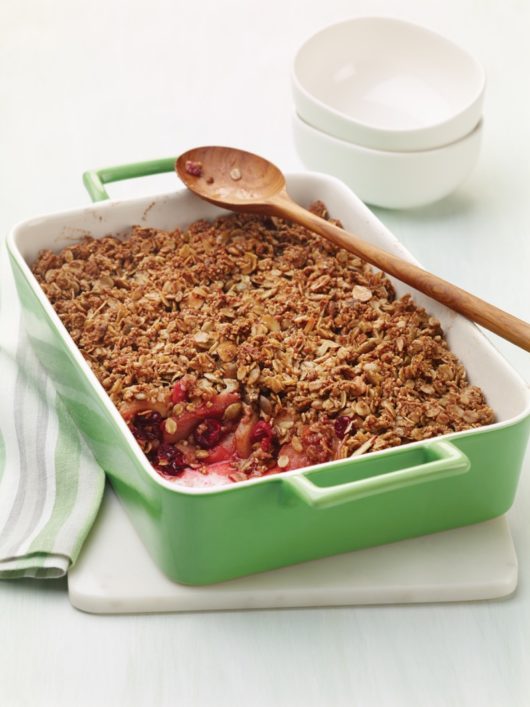
Cool weather cobbler
Think you don’t like to cook? Cavuto encourages readers to pick up her cookbook full of scrumptious, easy recipes, play a favorite mixed tape and simply get started. Most of her recipes can be on the table in a short time, especially the oven-baked dishes. “All you have to do is a little prep work then pop the dish in the oven and when the time goes off it’s ready,” says Cavuto. With a little planning and a few minutes in the kitchen, healthy dinner can be served in your house tonight.
Some of Cavuto’s own favorite recipes include smoky seafood stew, the frittata, everyday herb oil and Moroccan turkey with roasted veggies and cool weather cobbler (pictured above).
When you start eating truly and deeply nourishing food, you can forget the word “diet” as it’s defined in today’s society and eat as much as you want of the foods that you love and never have to fear them again. How great would it be to look at your meals and feel gratitude for being deeply nourished and truly healthy? Why not pick up Cavuto’s book and see for yourself!
Diwali is celebrated over several days, coinciding with the fall harvest, and traditionally, the darkest night of autumn. This year, the holiday falls on Sunday, October 30. Many Indian-Americans observe Diwali, which celebrates the symbolic victory of light over darkness, or good over evil. People decorate their homes and businesses with lamps (diya) and candles for the holiday. On the day of Diwali, families offer prayers (puja) to Lakshmi, the goddess of wealth and prosperity. The festival features fireworks, celebratory meals and the exchange of gifts and sweets (mithai). Diwali-themed street fairs and markets (melas) are also common from mid-October through mid-November.
With the third-largest Asian Indian population in the United States, New Jersey is home to many Diwali celebrations. New Jerseyans born in India, in fact, make up the highest share of our state’s foreign-born population. Edison, Jersey City, and Woodbridge have the largest Indian-American communities in the state.
Food, of course, is a centerpiece of Diwali’s public festivals and family gatherings. We are fortunate in New Jersey to have plenty of choices for excellent Indian cuisine, in many regional varieties. Whether you prefer North Indian meats stewed in complex spice mixtures or grilled in a clay oven (tandoor), flatbreads (roti, paratha, naan), and hearty rice biryanis, or fiery South Indian dishes like potato-filled crepes (dosas), spicy lentil stew (sambar), and steamed rice cakes (idli), you can find them all in Jersey.
Want to share in the festivities? Here are 10 restaurants across the Garden State where you can get a taste of the Diwali celebration. For the highest concentration of Indian restaurants head to Jersey City’s Little India, along Newark Avenue or to Oak Tree Road between Edison and Woodbridge—the central hub for Middlesex County’s South Asian community. Some Indian restaurants are vegetarian only. (Diwali meals are typically vegetarian, but many New Jersey Indian restaurants have both vegetarian and non-vegetarian menus. Visit EthnicNJ.com to see these restaurants—and a full list of New Jersey’s best spots for Indian food—on one map.
Aarzu Modern Indian Bistro – Freehold 30 East Main Street
732-333-0933
Opened in July, an upscale setting featuring modern Indian cuisine with creative flourishes. Serving a Diwali special tasting menu through October 30.
Bollywood Grill – Parsippany 435 North Beverwyck Road
973-257-1444
Popular Indian street food and snacks in a fast-food setting.
Brick Lane Curry House – Montclair 540 Valley Road
973-509-2100
Known for its impressive list of British-style curries, including both meat and vegetable masalas, kormas and vindaloos. There is a second NJ location at 34 Franklin Avenue in Ridgewood.
Dhoom – Secaucus 217 Route 3 East
201-210-2275
A Bollywood-themed restaurant, bar and lounge near the Meadowlands.
Dosa Grill – North Brunswick (Vegetarian) 1980 Route 27
732-422-6800
Offering a wide variety of dosas—South India’s signature street food—with both North and South Indian vegetarian dishes.
IndeBlue – Collingswood 619 Collings Avenue
856-854-4633
A fresh mix of modern and traditional Indian cuisine in the Philly suburbs.
Jassi Sweets – Woodbridge 1404 Oak Tree Road
732-283-4065
The tasty Indian sweets sold here are the perfect Diwali gift.
Jhupdi – Edison (vegetarian) 1679 Oak Tree Road
732-906-2121
Serving the cuisine of the Indian state of Gujarat, like thali platters, featuring both spicy and sweet vegetable mixtures and chutneys. The Gujarati New Year is traditionally celebrated the day after Diwali.
Myilai Masala – Hamilton 116 Flock Road
609-438-9288
Featuring the South Indian food of Chennai. Offering a Diwali special buffet through October 30th.
Sapthagiri – Jersey City (vegetarian) 804 Newark Avenue
201-533-8400
A must stop in Jersey City’s “Little India” for South Indian vegetarian cuisine. A second location is at 3151 Route 27 South, in Franklin Park.
Anthony Ewing is the founder of EthnicNJ, which celebrates the many cuisines and communities of New Jersey. EthnicNJ has mapped over 1,100 NJ restaurants serving some 65 different cuisines.
When people ask me to name my favorite New Jersey diner, I smile and reply that “it’s not a fair question.” It’s a legit curiosity that frequently comes up with audiences throughout the state as I do talks on my book, The History of Diners in New Jersey.There are plenty of “favorite” diners to enjoy, such as the Broad Street Diner in Keyport or Mustache Bill’s Diner on Long Beach Island, and new ones yet to be discovered, so there’s no need to pick just one. But I explain to people that the one diner most near and dear to my heart is the Tick Tock Diner, located on the westbound side of Route 3, in my hometown of Clifton.
Back in the early 1970s, on Saturday nights, my buddies and I were fond of dropping in at the Tick Tock after 1 a.m. to grab a bite to eat. Sure, we were hungry, but for us the main attraction was to see who else would be in the joint at that time of the night. It was a most entertaining assortment of characters: hippies, truck drivers, businessmen, Jersey girls, tourist, cops, politicians, formally dressed members of wedding parties, musicians, young and old lovers, and all sorts of wayfaring strangers.
This is the roadside human drama that defines Garden State diners. They’re part of our culture, part of our DNA. We drive fast, we eat fast, and there’s always plenty to talk about. It doesn’t matter who you are, where you come from, what you look like, or what time you show up—everyone always has a seat at a Jersey diner. As Pennsylvania diner historian Randy Garbin once told me: “diners are a haven for humanity. A meal at a diner can be 45 minutes of your life that you’ll never forget.”
These days I’m not much of a late-shift rambler. I’m usually in and out of diners well before the respectable hour of 11 p.m.
Recommended dishes at the Tick Tock? For supper, the Nicoise salmon salad is a delicious choice at the top of my list. The salmon is broiled to perfection. For lunch, the hot open turkey sandwich is a dependable classic and the best around. The lentil soup is a treat. What about breakfast? You’ll never go wrong with two eggs over easy, accompanied by well-done hash and home fries. The coffee is good, consistent and mellow. Dessert? Allow me to suggest the regal lemon merengue pie.
Friends and family members who join me for a meal at the Tick Tock bring their own culinary perspectives and appetites and make winning choices. Greek salad with spinach wraps, chocolate/banana crepes, veggie burgers with red onion and humus, and beef patty melts all have received rave reviews. And customers seem to thrive on the Tick Tock disco fries.
Beef patty melt
There have been three distinct iterations of the Tick Tock, all at the same location on Route 3. The original Tick Tock was a stainless steel Silk City diner car, built by the Paterson Vehicle Company of Paterson, and installed in 1952. Business flourished at the diner and in 1956 Silk City installed a modular dining room extension to keep up with demand.
In early April 1977, a second Tick Tock was unveiled: a boxy structure with large windows, carriage lamps and seating for more than 200 people, built by the Musi Dining Car Company Inc. of Carteret. The late Nick Ramoundos—the original owner—decided it was time to retire the old Silk City car in favor of a larger, more modern diner, in order to seize the opportunity to attract more customers, due to the opening of the Meadowlands sports complex. It was, no doubt, the correct business move at the time. But Ramoundos, like most other Tick Tock faithful, felt sad to say goodbye to the old diner car.
The third and current Tick Tock, built by Kullman Industries Inc. at its factory in Avenel (and manufactured in seven sections), opened on June 1, 1994. (The Musi-built Tick Tock was transported to Mays Landing on Route 40, and became the Mays Landing Diner.)
The current diner features decorative neon lights, glass bricks, a crimson facade, and stainless steel, all of which radiate a retro/contemporary charm. It also retains the classic neon rooftop sign, crowned with the Eat Heavy clock. The avuncular, animated Ramoundos, a larger-than-life figure, coined the expression “Eat Heavy” to greet his customers. This was his friendly way of saying come in, sit down, relax and enjoy a good meal. It was as much about the spirit of the moment as the good food itself. During its lifespan of 64 years, the Tick Tock has come to symbolize all that was and is in the mythic Jersey diner saga.
“Eat Heavy” my friends. My devotion to the Tick Tock is eternal. And one of these nights, if there is a harmonic convergence of the moon, stars, comets, galaxies and earth-bound situations, maybe, just maybe, you might see me stumble through the Tick Tock’s vestibule doors at 1:05 a.m.
Susan Bloom takes a look at some key openings around the Garden State this fall. Have a restaurant/food outlet opening, closing, or other key development to share? Email your news to [email protected].
Opened on September 24, this quick-service restaurant is founded on a “build-your-own, Mediterranean-fusion concept,” according to owner Nino Homsi. “Among our most popular menu items are our chicken shawarma, grilled vegetables, shrimp or fish of the day, and our 578 Beans—a blend of chickpeas with garlic and lemon juice,” said Homsi, who noted that prices for most dishes range from $6.92 to $9.82. “Guests begin with a bottom base of rice, wheat, salad, or flat bread, add a meat, fish, or vegetable, and then select from a number of toppings, including lettuce, tomato, onion, sautéed mushrooms, and more,” he explained of the ordering process. Decorated in shades of black with light blue trim and outfitted with refurbished wood and trendy industrial lighting, “we offer friendly service and great quality food for the money,” Homsi said.
Celebrating its grand opening with an official ribbon cutting on September 30, this craft brewery and tasting room focuses on classic and lower-alcohol European session beers. Among its nine styles currently on tap are an English Mild Ale, a Hefeweizen, a Saison, and a Pacifica hopped IPA. A hobbyist home brewer for the past 10 years, “this is a passion of ours,” shared Chris Burke, cofounder of Eight & Sand with business partner Chris Mazzone. With a cozy tasting room, relaxed backyard area, and bar accommodating a total of up to 180 people, Burke said that Eight & Sand offers a fun communal experience. “We focus on classic, flavorful beer styles that other brewers aren’t necessarily doing anymore and people love it,” said Burke, who added that while Eight & Sand doesn’t offer food, visitors are encouraged to bring their own. “We’re about hanging out, playing board games, and drinking great beer,” he said.
Opened this past spring in time to capitalize on the summer dining season, The Grand Tavern takes pride in featuring ingredients from local farms, butchers, and fishermen, including fresh fluke, salmon, and other catches from Local 130 Seafood in Asbury Park. Among other popular menu items, “we’re known for our great burgers, 36-ounce, dry-aged cote de boeuf served with a bearnaise sauce and French fries, and our delicious wines,” shared Antonio Pulgaron, one of the restaurant’s floor managers. Seating up to 100 people between its interior dining room and bar and outside dining and bar areas, “we’re a rustic French tavern decorated with exposed wood beam ceilings and a leather banquette against the wall,” Pulgaron said. “Guests will enjoy our cozy and comfortable atmosphere and thoughtfully-prepared menu of dishes, all made in-house with great attention to detail. The experience we offer from beginning to end is wonderful.”
Horseneck Tavern 11 Bloomfield Avenue
North Caldwell
973-287-6850
Opened on September 22, this eatery with an upscale American menu features such items as a Beet Salad with smoked raw pit gold beets, shaved horseradish, candied pistachios, and Humboldt Fog cheese as well as a roasted Amish chicken entrée and a 40-day-old dry-aged ribeye steak. “We also offer seasonal cocktails such as our Happy Mule, made with Ketel One Orange vodka, fresh lime and pineapple juice, and ginger beer and our ‘Autumn in Vermont’ bourbon drink garnished with an apple cider ice cube,” shared Manager Paula Correri. Décor within the 122-seat tavern includes cozy red banquettes anchoring the dining room and bar area and guests will enjoy live music on Thursday, Friday, and Saturday nights. “In addition to our friendly service and outstanding food, we have a vibrant and energetic atmosphere that’s casual and warm,” Correri said.
Celebrating its grand opening on October 11, Ibby’s offers all-natural, award-winning Halal recipes using healthy, farm-fresh ingredients that create a feast for the eyes and palate. “Everything is customizable,” explained cofounder Shetal Shah, a food service industry veteran and coffee master. “Our combo plate with greens or grains and a protein offers a choice from among six different chef salads and a variety of spreads including hummus, babaganoush, and Mediterranean avocado,” he said, “while our protein plate offers choices including falafel, chicken kebab, and shawarma over greens or grains.” Shetal said that Ibby’s also offers “the best coffee in the area,” including nitro brew options, a cold brew on tap featuring a delicious artisan coffee of single origin from Ethiopia, “and an American Drip that’s absolutely phenomenal,” he said. Residing in renovated space formerly occupied by Subway and seating about 45, Shetal said that customers have been very receptive to Ibby’s and enjoy the restaurant’s fresh and healthy fare.
Originally a popular food truck when it launched in 2009, The Taco Truck opened its first brick-and-mortar outlet in Hoboken in 2010 and proudly celebrated its grand reopening there on October 14, at which time it unveiled refreshed new flooring, artwork, and interior design. Among the sustainable, 20-seat outlet’s signature Mexican taqueria-inspired dishes are its Pescado Taco, featuring crispy catfish, red cabbage, pico de gallo, tartar, and chipotle salsa in a flour tortilla, Al Pastor Taco, made with marinated pork, onion, cilantro, pineapple, and fresh green salsa in a stone-ground warm corn tortilla, and Pollo Burrito, made with red rice, black beans, crema, grilled chicken, lime-pickled onion, and roasted red salsa in a flour tortilla. Following this site and other locations in Morristown and Princeton, opened in 2013 and 2014 respectively, cofounders Jason Scott and Chris Viola look forward to opening another location in King of Prussia, PA in late 2016. “We’re dedicated to providing our loyal local customers with an authentic experience and anticipate that our renovations will allow the community to continue to enjoy the high quality food and service they’ve grown to love for many years to come,” shared Scott, The Taco Truck’s CEO.
Piattino: A Neighborhood Bistro, one of Mendham’s most popular restaurants (and part of the 40NORTH Restaurants family, which includes The Black Horse Tavern and The Black Horse Pub in Mendham, The Office Tavern Grill in Summit and Morristown, and George & Martha’s American Grille in Morristown), has announced that it will bring its fresh, authentic, new age Italian cuisine to the Summit dining scene this winter. Located next door to The Office Tavern Grill, Piattino’s second North Jersey restaurant location will offer guests a variety of mouthwatering antipastis, insalates, homemade pastas, and more served in a warm, chic, and cozy setting. Known for its delicious, hand-stretched Neapolitan-style pizzas and sandizzas (its own version of a panini) baked fresh at 800 degrees in its imported Italian stone-fired oven, Piattino has a reputation for using premium ingredients ranging from truffled wild mushrooms to 24-month-aged prosciutto di Parma. The restaurant will also offer a full bar, house-made cocktails, and extensive wine selections by the bottle and glass. “Piattino has been a great restaurant concept for us and with our new location in Summit, we’re looking at expanding the menu, the experience, and the brand,” shared Kevin Felice, corporate executive chef for 40NORTH Restaurants. “Summit will feature seven new menu items as well as an expansive cured meat and imported cheese section. We’re stepping up our game and making our pastas in-house, taking Piattino to another level,” he said.
Summit House 395 Springfield Avenue
Summit
908-273-6000
In early 2017, diners will enjoy the grand opening of Summit House, a new seasonal American restaurant in Summit that will feature the culinary expertise of Executive Chef Martin Kester, the former chef de cuisine at Ninety Acres in Peapack, as well as the creative cocktail program overseen by Tad Carducci, half of the renowned mixologist duo The Tippling Bros. Seating about 120 with private dining facilities for another 20 guests and featuring an open-kitchen dining room, the restaurant is set to offer “truly exceptional food in an atmosphere that guests would want to visit any day of the week,” said Dylan Baker, Summit House’s operating partner. The menu, which will source the finest ingredients at their peak of freshness from neighboring farms, fishermen, and other purveyors, will include seasonal produce, pasture-raised beef, fresh and sustainably-caught seafood, and house-made pastas as well as a raw bar featuring a daily rotating selection of East Coast oysters from cold Atlantic waters. “Our extensive craft cocktail program, beers, and wines by the glass will also evolve with the seasons in order to provide the best possible experience for our guests,” added spokesperson Mason Levinson. According to its owners, Summit House will be the first new restaurant with a liquor license to open in Summit in a decade.
All images are courtesy of the restaurants featured.
Beyond the traditional favorites we all know and love, there’s a world of vino just waiting to be discovered by the masses. Hugh Preece, operating partner at SaltCreek Grille – Princeton, shares a few of the gems he learned about during an experience in Italy, where he was part of an intensive VinItaly tour.
Dolcetto means “little sweet one,” although its wines are never sweet and is resolutely dry. In Piedmont there are 11 DOC wines. Dolcetto d’Alba has the fullest body and in Dogliani has floral, fresher, more perfumed and can be most powerful. In a region where Nebbiolo is king, Dogliani area has always viewed Dolcetto as its most important cultivator. Dolcetto wines are cleansing, unique, fresh and medium bodied with grapey aromas and flavors, and bright acid.
Wine to try:Pecchenino Siri d’Jermu Dogliani Superiore DOCG Today Pecchenino consists of 54 acres and brother Orlando and Attilio run the family business of over four generations. This single vineyard wine is fermented in stainless and aged in French oak one year and bottled six months. Ripe fruit on the nose with notes of currants, black fruit, balanced flavor and smooth with sweet tannins with a finish that lingers.
Sagrantino is an ancient grape found in Umbria. Some theorize that its name is derived from “wine of the mass” due to the amount of tannins in the wines (and therefore able to age well). The DOCG wine is called Montefalco Sagrantino and is 100% varietal. Wines produced in Montefalco are more structured yet refined, while those produced in Bevagna are more floral and elsewhere softer and more ready to drink. Sagrantino’s history has always been sweet wine and dry Sagrantino is only a recent movement. Sagrantino is Italy’s most tannic red wine. The tannins are polished and smooth and should be rich with prickly black fruit, aromatic herbs and flavors that are pure and persistent.
Wine to try: Falesco Montefalco Sagrantino RC2 Brothers Riccardo and Renzo Catarella founded Falesco in 1979. This wine is fermented in stainless, cold soaked maceration and aged in new French oak for 2 years and bottle for 8 months. The aromas of black fruit, blackberry are intoxicating with nuances of black cherry, tobacco and graphite. Palate supports the nose with fine grain tannins and a silky mouth feel with super structure and balance.
Primitivo got its name in Italy because it ripens very early in the season, in August. Puglia is its main Italian home and is one in the same as the California Zinfandel. Primitivo should be creamy-rich with aromas of ripe red cherry, strawberry jam and plum macerated in alcohol with nuances of tobacco and underbrush, herbal and tarry. The main difference with the California Zinfandel is its stronger herbal nuances and less ultra ripe, sweet fruit.
Wine to try:Castello Monaci Salento Primitivo Piluna Castello Manaci is located in Puglia (the “heel of the boot”) and is certified sustainable. The grapes are harvested in early morning with part of the wine being matured in French barriques for six months and the rest in stainless. A wine with body and structure and has a full bouquet of ripe red fruits, notes of pepper and vanilla. Robust and concentrated, soft but firm flavors.
We welcome fall with thoughts of leaves turning blazing orange and red and the desire to eat food in those autumnal colors. I love butternut’s cheerful orange flesh so much, I teach a One Ingredient, Five Ways class taking this winter squash through a five-course meal. It really is that versatile. Butternut happily stars in a meal’s main event. Feeling cheesy? I add pureed squash to a sharp cheddar and Gruyere cheese sauce for my butternut squash macaroni and cheese. Top it with a crunchy layer of buttery Panko breadcrumbs and fragrant rosemary for a dinner you’ll keep in heavy rotation all through fall. Switch it up with rigatoni instead of elbows and add sautéed greens, bacon and caramelized onions for a version to impress company. You just may get a standing ovation. For a lighter pasta option, I toss chunks of roasted squash, arugula, lemon zest and a bit of Parmesan with fettuccine or penne. Roasting butternut squash before using it in soups or stews will enhance its sweetness.
Peel the entire squash and cut between the bulb and neck of the squash to make breaking it down more manageable. Now you can get evenly cut slices or cubes from the neck of the squash. Remove the seeds and reserve. Cut the flesh from around the seed cavity in half-rounds. Roast in an oven at 375 degrees with a small amount of oil, salt and pepper for 25 to 35 minutes. If you are in a hurry, just slice down the middle and roast cut-side up. When tender, remove the seeds and drizzle the squash with maple syrup and chopped pecans for a great side dish. It also makes a fine fall crostini when spread on toast with ricotta cheese. To make a soup, sauté other ingredients; add roasted squash and chicken or vegetable stock, and simmer. I often make a rich, creamy, dairy-free soup with ginger and unsweetened coconut milk. Puree in a blender, being careful when you are working with the hot liquid. Get creative with your flavoring additions. Because butternut is sweet, trying adding some heat with Sriracha or chipotle peppers. Rinse the seeds and remove fibrous strands. Pat dry and dust with salt and chili powder, cumin or pumpkin pie spice and toast in the oven. Use these crunchy bits as a garnish for salads, tacos or soup. Dessert ideas abound. Substitute pureed butternut in pumpkin pie recipes. Partnered with apples, pears and dried fruits, it can make a tasty pie or galette filling. Or perhaps slip some puree into brownies or chocolate cake. Butternut squash can be stored at room temperature on the counter for about two weeks or in a cool, dry, dark location for two to three months. Try not to allow them to rest against a hard surface or other squash as soft spots may develop. Swaddle them with a crumpled newspaper or paper bag.
Butternut Squash Macaroni and Cheese
Ingredients: 1 large butternut squash, peeled and diced
2 onions, diced
2 Tbsp. olive oil
1 lb elbow, penne or rigatoni pasta
4 Tbsp. butter
4 Tbsp. flour
2½ cups milk, divided
pinch of nutmeg
salt and white pepper
8 oz cheddar cheese, shredded
8 oz swiss cheese, shredded
2 cups bread crumbs
1 stick melted butter
3-4 Tbsp fresh rosemary chopped
Directions: 1. Preheat oven to 375 degrees. Peel, dice butternut. Toss with olive oil, salt and pepper. Bake until tender approx. 30-35 minutes.
2. Caramelize onions. In a sauté pan, heat olive oil and cook onions until very soft and brown. Stir occasionally. Add 1-2 Tbsp. water to loosen from bottom of pan if necessary while cooking.
3. In a food processor, puree the butternut squash, caramelized onions and ½ cup milk. Set aside.
4. In a sauce pan, melt the butter. Whisk in flour to create a roux. Cook until it it lumpfree and creamy like peanut butter. Slowly add the rest of the milk. Cook until sauce thickens. Season with nutmeg, salt and white pepper.
4. Cook pasta just until al dente.
5. In a large bowl, combine squash puree and sauce. Stir until smooth. Fold in pasta.
6. In a buttered 9 x 13 baking dish,spread half the mixture. Top with half of the shredded cheese. Add another layer of pasta mixture and top with remaining cheese.
7. Combine bread crumbs with melted butter and rosemary. Season to taste with salt and pepper. Sprinkle over top of the macaroni and cheese.
8. Bake, uncovered, in a 350 degree oven for 30-35 minutes.
9. The bread crumbs will be golden brown.
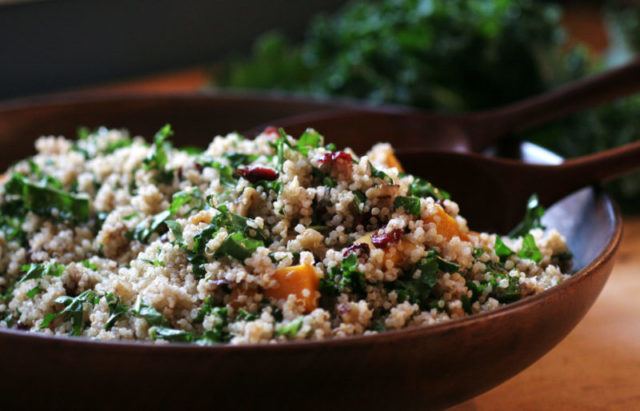
Quinoa, Kale, Cranberry, Walnut and Butternut Squash Salad
(pictured at top)
Ingredients: 1½ cups quinoa
3 cups water
2 Tbsp. olive oil
1 red onion, diced
2 garlic cloves, minced
1½ cups butternut squash, peeled, ½ inch dice
1½ cups kale, ribs removed, ½ inch ribbons
½ cup dried cranberries
½ cup chopped walnuts
kosher salt and freshly ground pepper
Dijon vinaigrette
1 Tbsp. balsamic vinegar
1 clove garlic, minced
1 teaspoon Dijon mustard
1 teaspoon raspberry jam
¼ cup olive oil
Directions:
1. In a large saucepan, bring the quinoa, ½ teaspoon salt and the water to a boil. Reduce the heat to low, cover and simmer for approximately twenty minutes until the tail of the quinoa unfurls. Remove from the heat, fluff with a fork and place in a large bowl to cool for 20 minutes.
2. While the quinoa is cooking, heat the olive oil in a large skillet, add the onion and cook until it turns translucent. Add the garlic and butternut squash. Cover with a lid and cook for about 10 minutes on medium-low heat until the squash is tender when tested with the tip of a knife. Season with salt and pepper to taste. Let cool to room temperature.
3. In a small bowl, whisk together the garlic, vinegar, Dijon mustard and jam. In a steady, slow stream add the olive oil while whisking continuously. Season with salt and pepper to taste.
4. Gently fold the cooked vegetables, quinoa, kale together with the vinaigrette, dried cranberries and walnuts.
5. Serve room temperature or cold.
For more recipes and information about Rachel Weston, check out her website.
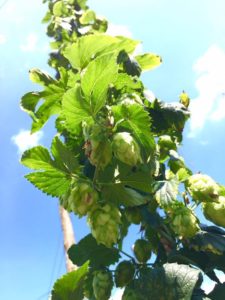
Hops ready to be picked at Fir Farm. Credit Mandy Hanigan
You won’t find harvest ale in the Certified Beer Judge style guide, but you will find it on taproom chalk boards in breweries around the state.
What is harvest ale? It’s really a beer that celebrates the fall harvest by incorporating the bounty of the summer growing season. While you might be thinking apples, cranberries, and pumpkins (oh my), it’s also the harvest season for hops. So, for many, harvest ale means fresh hops. And by fresh hops I mean hops that are in the brew kettle within 48 hours of being picked. (For more on NJ hop growing, see my article here.) These just-off-the-bine hops are also referred to as “wet” hops because they aren’t kiln dried like their processed and pelletized brethren. Whatever you call them, they impart crisp green flavors and aromas that just can’t be duplicated any other way.
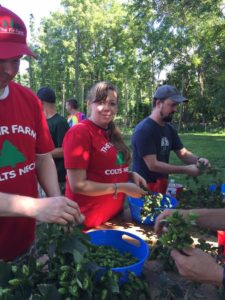
Jughandle staff at the Fir Farm hop harvest. Credit Mandy Hanigan
Jughandle Brewing, in Tinton Falls, traveled a few miles down the road to The Fir Farm in Colts Neck to get their fresh hops. Utilizing organic and sustainable farming practices, the Fir Farm began growing hops in 2015 and provided harvest ale hops for no less than 5 New Jersey breweries. Dark City, Backward Flag, Ship Bottom, Brix City as well as Jughandle all showed up for the harvest.
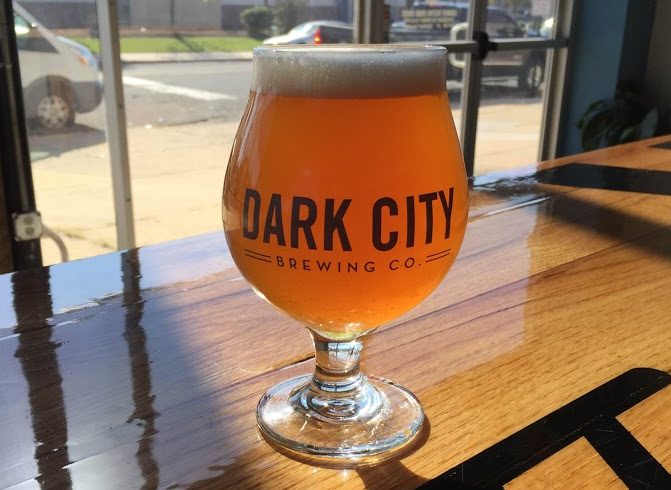
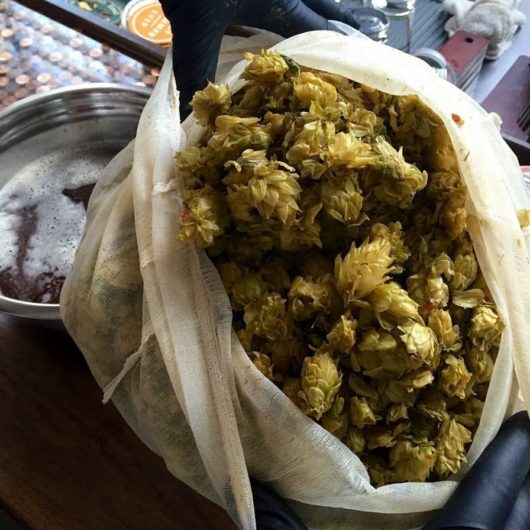
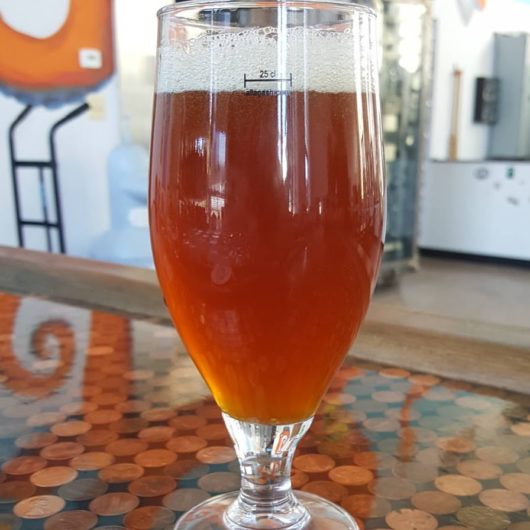
Mike Skudera of Jughandle tells me that his version is a session (4.8% ABV) amber ale that showcases the locally picked Chinook and Cascade hops. Dark City, of Asbury Park, went in a different direction. They decided that their first IPA would be something special. Kevin Sharpe brought his staff to The Fir Farm and picked 70 lbs. of Cascade, Nugget and Chinook hops. The result is Local Summer, a juicy, balanced IPA whose flavor is “slightly earthy/vegetal as you expect from fresh wet hops”. As a shore resident, the name alone is enough for me to raise a pint.
Hops are characterized as the herbs or spice that season a brewers wort. Up in the hill country of Warren County, Well-Sweep Herb Farm discovered a roadside wild hop and cultivated it. Man Skirt Brewing in Hackettstown used this variety, grown by friends Mark Sloan and Kate Munning, for their upcoming Hop Jostler IPA. It’s going to be a milder English style. “It starts off with some malty sweetness, then the fresh hops bring a bright fruitiness, along with a clean, dry finish. Very easy to drink with plenty of flavor to satisfy your inner hop-head.” according to owner Joe Fisher. If you’re wondering about the name, stop by the brewery for a pint of this taproom-only beer and ask Joe yourself.
Fresh hops grown for Man Skirt Brewing
Down south, all the way to Cape May Brewing, they aren’t satisfied with just using New Jersey hops. For them, it’s all in with all New Jersey everything. Three Plows—named for the three plows on the state seal—is the first beer sourced entirely from the Garden State. On October 20, Cape May Brewing will play host to East Coast Yeast (Hillsborough), Rabbit Hill Farms (Shiloh—providing the malt) and Laughing Hops (Pennington) to brew this historic IPA. Assistant Secretary of Agriculture Alfred W. Murray is also expected to be there. The beer should be released in early November so check back here for an update in a few weeks.
Hop Jostler IPA from Man Skirt Brewing
Here’s a final thought on harvest ale. Most of them are small batch brews and are usually limited in quantity. When they’re gone, they’re gone. In many cases, you’ll have to travel to the brewery to get a taste as they don’t get past the brewery door. Harvest ale pairs well with leaf peeping. Enjoy the season.
Cape Brewing is planning an all-New Jersey-sourced beer.
Pictured at top: Dark City Local Summer fresh hop IPA.
Jersey Bites is a proud sponsor of Forks, Corks & Hops
The Algonquin along with sponsors including the OceanFirst Foundation, Whole Foods Market Wall, Brook 35 & West, Jersey Bites and the Garden State Wine Growers Association, presents Forks, Corks & Hops: a wine and cheese pairing event. This year’s event will be on November 14, from 6 p.m. to 9 p.m. at The Mill, 101 Old Mill Road, Spring Lake Heights. Guests will enjoy a selection of award-wining New Jersey wines paired with cheeses from Whole Foods Market. For VIP members, the wine and cheese pairing begins at 5:30 p.m.
We have tickets to give away! Check out the sweepstakes at the end of this article for details and to enter!
Forks, Corks & Hops presents guests with a unique opportunity to sample a number of dishes from area restaurants, along with a variety of premier wines, beers and inventive cocktails from local distributors.
Tom Cosentino, Executive Director of G.S.W.G.A., hosts this year’s event. Guests will enjoy live music from the Paul Marino Band and Bruce Foster. All attendees must be 21 years or older, and guests should dress in business attire.
If you’re like me, the term veggie burger may, at first, feel somewhat oxymoronic. After all, how could a patty-shaped amalgamation of vegetables possibly compete with the unctuousness of a great burger made from nothing but beef?
Upon trying some of the delicious offerings from Jersey City Veggie Burgershowever, I realized just how wrong I’ve been.
Started in 2012, Jersey City Veggie Burgers began as the result of founder Liz Migliore’s strive to create a better veggie burger for her vegetarian husband. “I wasn’t thrilled with the grocery store options,” Migliore says.
Since then, Jersey City Veggie Burgers has frequented the New Jersey farmers’ market scene, attending both the Princeton Farmers Market and the Riverview Farmers Market, to name a few. The burgers are also featured on the menu at six restaurants in New Jersey, including Stuffed grassfed burgers in Montclair and Left Bank Burger Bar in Jersey City, and can be found on the shelves of nearly a dozen grocery stores throughout the state.
After four successful years in business, Jersey City Veggie Burgers is shifting its sights from farmers markets to retail distribution, so it’s likely that the burgers will be making an appearance at many more grocery stores soon.
While Migliore is enthusiastic to make the change in order to keep up with increasing demand, the transition is bittersweet. “I’ve loved doing farmers’ markets,” she says. “It’s been a great way to meet customers and just become friendly with so many people through that avenue.”
With a lineup that consists of a trio of delicious vegan, soy-free burgers, made from ingredients that are locally sourced and organic whenever possible, it’s no surprise how popular Jersey City Veggie Burgers have become.
From the West African-inspired sweet potato collard green burger, to the molto Mediterranean white bean broccoli rabe burger, to the spiced-up, Tex-Mex Three Sisters burger, each variety is packed with its own unique flavor and it certainly won’t be long before shoppers find their favorites.
The sweet potato collard green burger was the first burger Migliore developed. It remains her personal favorite since “it was the first one and the one that I eat most often just because it’s very hearty.”
While the burger was inspired by a trip Migliore took to West Africa, its flavor also highlights the similarities between West African cuisine and American comfort food. “I was really fascinated to find there that a lot of the food there shares ingredients with comfort food in the South, like sweet potatoes, peanuts, greens, and things like that,” says Migliore.
Creating the recipe for the sweet potato collard green burger was a labor of love. “I worked on that for about a year to a year and a half,” explains Migliore. “It took a while to get the balance of ingredients and the consistency right. The other ones came a little more quickly.”
The other two-thirds of the Jersey City Veggie Burger lineup may not have taken as long to perfect, but that doesn’t mean that they’re any less distinctively delicious.
The white bean broccoli rabe burger, inspired by a similar dish made by Migliore’s father, brings together the richness of smooth white beans paired with flavorful broccoli rabe, along with Mediterranean vegetables, olive oil, fresh lemon juice, and garlic, painting a delectable vignette of Italian home cooking on a bun.
The Three Sisters burger brings its flavor inspiration stateside, alluding to the savory spices of the Southwest. The burger gets its name from three key ingredients: pinto beans, corn, and squash. Lime juice and poblano pepper add a further kick of flavor, making the Three Sisters burger even more unmistakably Tex-Mex.
In celebration of Jersey City Veggie Burger’s move to retail, I decided to try some of their burgers for myself. What made this occasion even more momentous is that these were the first veggie burgers I’ve ever had—really! I chose to try both the sweet potato collard green burger as well as the Three Sisters burger and could not have been more pleased with my selection.
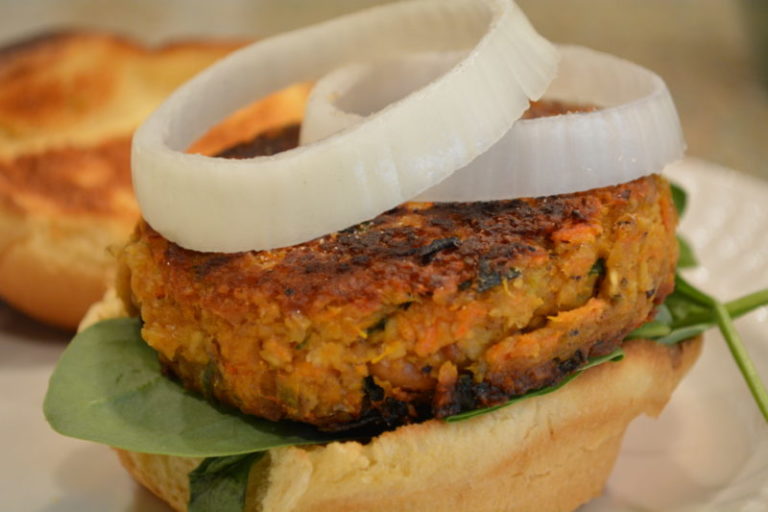
Migliore recommends that the best way to prepare the veggie burgers is “in a cast iron skillet or a pan on a stove. I like the cast iron skillet because it gives the burger better color and texture. All you need is a little bit of oil and medium heat.” After trying this method for myself I would say I certainly agree. The exterior of both burgers caramelized and crisped up excellently from the heat of the cast iron skillet, while the inside remained tender and rich.
The flavor of the sweet potato collard green burger was tastefully balanced between the welcome pairing of sweet and savory. The sweet element of the burger—the sweet potato, of course—made the burger warm and comforting, bringing to mind memories of sweet potato casserole my family makes for Thanksgiving each year. This sweetness was far from overbearing however, as the burger was still plenty savory. This was primarily due to the inclusion of peanuts throughout the burger, along with the hearty collard greens. I was especially fond of the salty nuttiness provided by the peanuts since admittedly, one of my favorite burger toppings is peanut butter—heresy, I know. The peanuts also added a degree of umami meatiness to the burger, enough to convert even the most fervent burger traditionalists.
Upon trying the Three Sisters burger I was immediately won over by the spiciness provided by the poblano pepper. The degree of spice certainly isn’t enough to deter those with an aversion to spice, but rather elevates the flavor of the burger as a whole. I found the Three Sisters burger to be more similar to a beef burger than the sweet potato collard green burger as it was even savorier, paired with elements of spice and smoke.
Ultimately, they both were delicious, wholesome, and healthful alternatives to beef burgers. So whether you’re a vegetarian, a veggie burger lover, or someone like me who was too stubborn to accept that veggie burgers can be just as good, if not better than its meat-made equivalent, keep a lookout for the Jersey City Veggie Burger lineup as their offerings begin stocking shelves at grocery stores near you.
For more information about Jersey City Veggie Burgers and where you can find them, visit the website and Facebook page.
Simply stated, you’ll love Enoteca Ursino. This stylish restaurant with a creative Italian flair is located on the Kean University campus in Union in the state-of-the-art Center for Science, Technology & Mathematics. Convenient to major highways and mass transit lines, it is a perfect dining destination when visiting local theaters or whenever you are in the area and looking for a fabulous meal. Now open for lunch, happy hour, and dinner (and with convenient parking), we suggest you gather your group and make plans to visit. This spot will likely become one of your favorites.
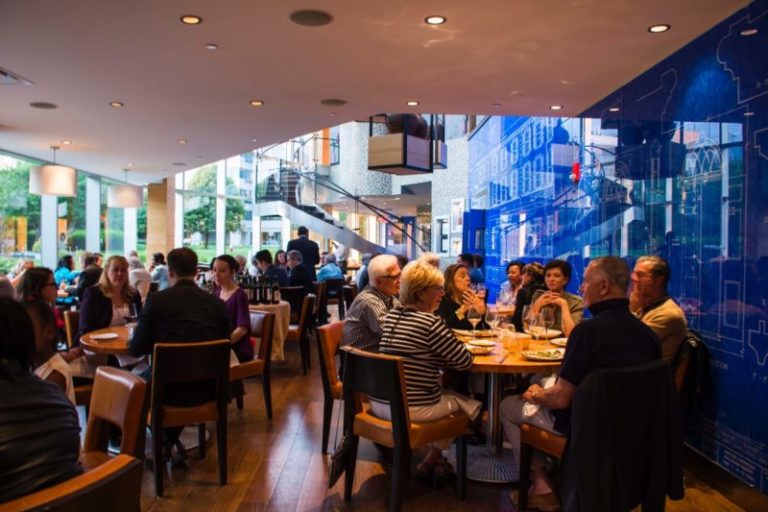
Enoteca Ursino has a classic, yet contemporary, ambiance. The grand two-story windows invite guests look out on the scenic grounds. The main floor features a horseshoe-shaped bar and tasting room that accommodates up to 60 guests and overlooks the main dining room, which is located on the lower level, and seats up to 85 guests. While all spaces throughout the venue are available for private dining, parties of up to 10 may prefer the enclosed wine room, which offers a more intimate setting. The gracious wait staff is helpful and pleased to discuss the menu.
The restaurant, which serves farm-to-table cuisine is founded on the mission to provide locally sourced, sustainable dining in a totally approachable manner. Working closely with the university’s Liberty Hall Farm, Enoteca Ursino features fresh, local, and seasonal ingredients.
Executive Chef Scott Tolhurst has designed an Italian-inspired menu with classic and specialty pizzas, a great choice of starters, tempting entrees and house made pastas. The menu offers something for everyone and has choices to suit all dietary preferences.
Executive Chef Scott Tolhurst
Enoteca Ursino in action
House made agnolotti
We started our dining adventure with a sharing plate, Il Picollo, a delectable plate of artisanal salumi and formaggi. We were tempted order an appetizer of pan-seared octopus or veal meatballs but chose one of the salads with freshly picked greens as a starter. The Liberty Hall Farm Greens option is a delightful combination of sungold tomato, watermelon, radish, and cucumber with light balsamic vinaigrette. A distinctive pasta specialty that you won’t find anywhere else is their house made Agnolotti made with Fulper Farms ricotta on a bed of Jersey sweet corn with pancetta, finished with lemon verbena and lime zest. There’s a very nice selection of seafood and meat entrees. We selected the tender and flavorful oven-roasted Amish chicken, served with fingerling potato and baby lacinato kale with lemon and salsa romesco.
I appreciated the beverage program at Enoteca Ursino, which creates perfect pairings with the menu. The wine list is very impressive. As a matter of fact, the translation of the Italian word, enoteca is “wine repository.” The restaurant has a regional and terroir-driven wine list. There is also an exciting cocktail menu that includes drinks like the Germain Sailor (with Bluecoat gin, St. Germain, prosecco, rosé, ginger bitters, and mint) or the Rye Not (with High West rye, Six Grapes ruby port, aperol, and lemon). For those who prefer, there is bottled beer as well as draft selections like Stone IPA and Two Roads Saison.
A fine meal has a great finish, and dessert at Enoteca Ursino shouldn’t be missed. We suggest the special twist on the Italian zeppoli: the light, scrumptious Bombolinis with lemon ricotta and Meyer lemon sauce. They also serve a luscious chocolate torte, sorbet and ice cream. Relax over coffee or an aperitif and enjoy the wonderful ambiance that will convince you to return soon.
Did we mention happy hour? Drop by and relax at the bar or the high top tables in the lounge from 4:00 p.m. to 7:00 p.m., Tuesday to Friday. Order $6 wine by the glass, $4 draft beer, specialty cocktails, wood-fired pizzas (like margherita or Shibumi mushroom) and a wonderful variety of small plates.
Enoteca Ursino is a world-class dining experience. It is a part of the Terra Momo Restaurant Group, co-owned by Carlo and Raoul Momo. The group is renowned in the Princeton area for popular, exquisite eateries. “The Terra Momo Restaurant Group has always focused on superior hospitality and sustainable sourcing,” Carlo Momo has said. “Raoul and I are fortunate to have been able to unite with Kean University and Liberty Hall to create this new destination that is a testament to our company and community ethos.”
Enoteca Ursino Restaurant and Bar is located at 1075 Morris Avenue. Convenient parking is available. Enoteca Ursino joins the Terra Momo Restaurant Group in the addition to Eno Terra, a wine bar and restaurant, Mediterra, a Mediterranean restaurant featuring a Tapas Bar, Teresa’s Caffe, an artisan pizzeria and café and Terra Momo Bread Company, an artisan bread store.
In the craft beverage world the onset of fall means a barrage of all things pumpkin. I’m not a pumpkin hater per se, but there must be another way to celebrate the autumnal equinox.
There is. It’s cider. How about cider from a region that, historically, is one of the best cider producers in the world? I’m talking, of course, about Newark, New Jersey.
Ironbound Hard Cider, one of the state’s newest cider works, located in rural Asbury (more on Newark later), just started turning out canned six packs of hard cider. It’s a fairly complex drink whose flavor profile lands directly between the bone dry artisan style and the sweet, mass produced, juice concentrate alco-pop variety. It’s sharp enough to refresh the palate when you’re eating rich fatty foods like barbecue or grilled sausage, but sweet enough for a light salad or Asian-style fare. If you’re curious about cider, Ironbound is a good place to start. There’s enough going here to please a wide audience and that burst of apple on the nose is inviting indeed.
Appealing to the masses is just what owner Charles Rosen, who also owns the adjacent New Ark Farms, is looking to do. “We want to be the Boston Lager of cider,” he told me during my recent visit. In case you didn’t know, Boston Lager is the flagship brand of Boston Beer Company, whose founder, Jim Koch, was a pioneer who helped change the way people thought about beer back in the days of only bland, light, American lagers. There is great irony in Rosen’s statement. His product is a direct response to the Angry Orchard brand cider which just happens to be owned by that same Boston Beer Company. While Angry Orchard may be made from overseas juice concentrate, Ironbound certainly is not. It’s all fresh juice.
Charles Rosen
Challenging such a large producer might seem like a weighty gauntlet to toss but Rosen has been around the block. He was a partner in an advertising agency that helped roll out New Belgium’s iconic Fat Tire Amber Ale as well as Mike’s Hard Lemonade. Ironbound isn’t going to compromise on ingredients though. Cameron Stark, Ironbound’s cider maker, creates the flavor profile with fresh juice from Pennsylvania and New Hampshire. Both Stark and Rosen are passionate about local sourcing. Our two-hour conversation was peppered with terms such as “regenerative agriculture” and “healing the land.” Charles Rosen is out to prove that responsible, regenerative farming can be part of a viable and profitable business model.
As Rosen describes it, Ironbound Cider is “what we call accessible craft” and is the key to proving that theory. His adjacent farm, New Ark, is the other lynch pin. Eventually its orchard will produce some, though not all, of the juice needed for the cider works. He will also cultivate other area growers by providing trees to them, for free, and then buy the juice that they make at fair prices.
Which brings us to Newark. Before the Industrial Revolution, when Newark became one of the largest beer brewing centers in the country, the area had been renowned for its orchards and world class cider. Dubbed the “Champagne of Ciders,” it was often passed off as such by unscrupulous merchants. The heart of Newark’s cider juggernaut was the Harrison apple. Like the area orchards themselves, it all but disappeared. It also became Charles Rosen’s inspiration to revive the glory days of Jersey cider. Following a suggestion from Newark Sustainability Officer Stephanie Greenwood, Rosen employed an apple detective—who knew that was a thing?—and tracked down some trees in Virginia that were being cultivated with cuttings taken from perhaps the last known Harrison apple tree.
Rosen reunited some of those cuttings with their home state and now has about 7,000 of the 18th century heirloom trees growing on New Ark Farms. To complete the story, the farm employs Newark kids who are getting the opportunity to learn a trade while actually keeping the operation running. They can then bring those skills back to the city and start a new cycle.
There’s a lot more than just bright, sparkling hard cider in every can of Ironbound. There’s history, renewal, and hope.


 Diwali is celebrated over several days, coinciding with the fall harvest, and traditionally, the darkest night of autumn. This year, the holiday falls on Sunday, October 30. Many Indian-Americans observe Diwali, which celebrates the symbolic victory of light over darkness, or good over evil. People decorate their homes and businesses with lamps (diya) and candles for the holiday. On the day of Diwali, families offer prayers (puja) to Lakshmi, the goddess of wealth and prosperity. The festival features fireworks, celebratory meals and the exchange of gifts and sweets (mithai). Diwali-themed street fairs and markets (melas) are also common from mid-October through mid-November.
 Food, of course, is a centerpiece of Diwali’s public festivals and family gatherings. We are fortunate in New Jersey to have plenty of choices for excellent Indian cuisine, in many regional varieties. Whether you prefer North Indian meats stewed in complex spice mixtures or grilled in a clay oven (tandoor), flatbreads (roti, paratha, naan), and hearty rice biryanis, or fiery South Indian dishes like potato-filled crepes (dosas), spicy lentil stew (sambar), and steamed rice cakes (idli), you can find them all in Jersey.
 Dosa Grill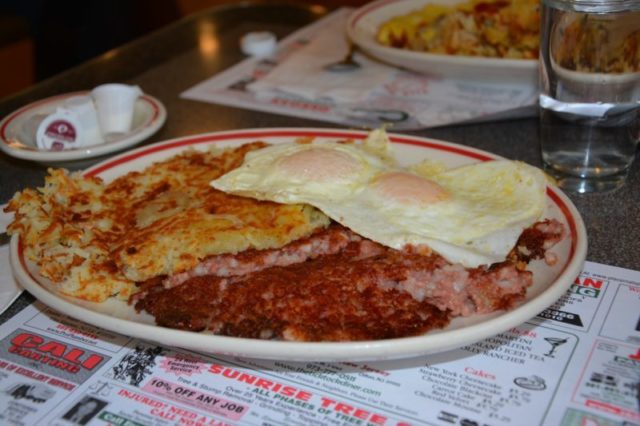
 Recommended dishes at the Tick Tock? For supper, the Nicoise salmon salad is a delicious choice at the top of my list. The salmon is broiled to perfection. For lunch, the hot open turkey sandwich is a dependable classic and the best around. The lentil soup is a treat. What about breakfast? You’ll never go wrong with two eggs over easy, accompanied by well-done hash and home fries. The coffee is good, consistent and mellow. Dessert? Allow me to suggest the regal lemon merengue pie.
 The current diner features decorative neon lights, glass bricks, a crimson facade, and stainless steel, all of which radiate a retro/contemporary charm. It also retains the classic neon rooftop sign, crowned with the Eat Heavy clock. The avuncular, animated Ramoundos, a larger-than-life figure, coined the expression “Eat Heavy” to greet his customers. This was his friendly way of saying come in, sit down, relax and enjoy a good meal. It was as much about the spirit of the moment as the good food itself. During its lifespan of 64 years, the Tick Tock has come to symbolize all that was and is in the mythic Jersey diner saga.


 rst brick-and-mortar outlet in Hoboken in 2010 and proudly celebrated its grand reopening there on October 14, at which time it unveiled refreshed new flooring, artwork, and interior design. Among the sustainable, 20-seat outlet’s signature Mexican taqueria-inspired dishes are its Pescado Taco, featuring crispy catfish, red cabbage, pico de gallo, tartar, and chipotle salsa in a flour tortilla, Al Pastor Taco, made with marinated pork, onion, cilantro, pineapple, and fresh green salsa in a stone-ground warm corn tortilla, and Pollo Burrito, made with red rice, black beans, crema, grilled chicken, lime-pickled onion, and roasted red salsa in a flour tortilla. Following this site and other locations in Morristown and Princeton, opened in 2013 and 2014 respectively, cofounders Jason Scott and Chris Viola look forward to opening another location in King of Prussia, PA in late 2016. “We’re dedicated to providing our loyal local customers with an authentic experience and anticipate that our renovations will allow the community to continue to enjoy the high quality food and service they’ve grown to love for many years to come,” shared Scott, The Taco Truck’s CEO.










 Which brings us to Newark. Before the Industrial Revolution, when Newark became one of the largest beer brewing centers in the country, the area had been renowned for its orchards and world class cider. Dubbed the “Champagne of Ciders,” it was often passed off as such by unscrupulous merchants. The heart of Newark’s cider juggernaut was the Harrison apple. Like the area orchards themselves, it all but disappeared. It also became Charles Rosen’s inspiration to revive the glory days of Jersey cider. Following a suggestion from Newark Sustainability Officer Stephanie Greenwood, Rosen employed an apple detective—who knew that was a thing?—and tracked down some trees in Virginia that were being cultivated with cuttings taken from perhaps the last known Harrison apple tree.