Indian Flavors Meet Indian Whisky
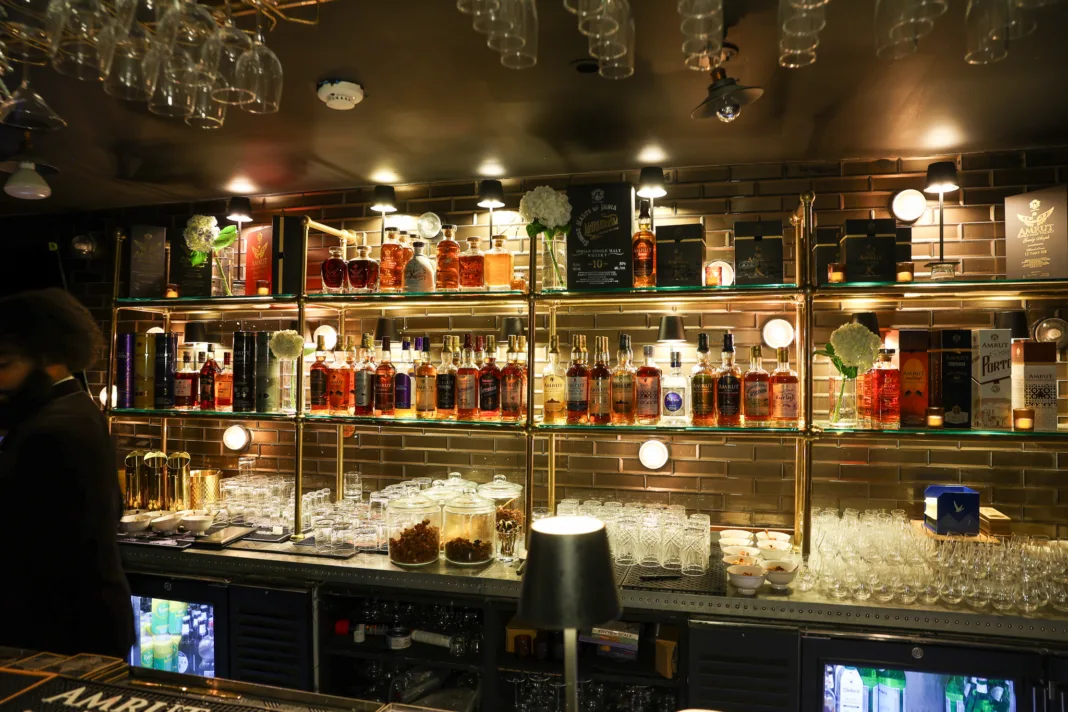
Tucked away in the basement beneath Brick Lane Curry House at 136 Newark Avenue in Jersey City, House of Amrut is the passion project of Sati Sharma, a longtime restaurateur and self-described Amrut superfan.
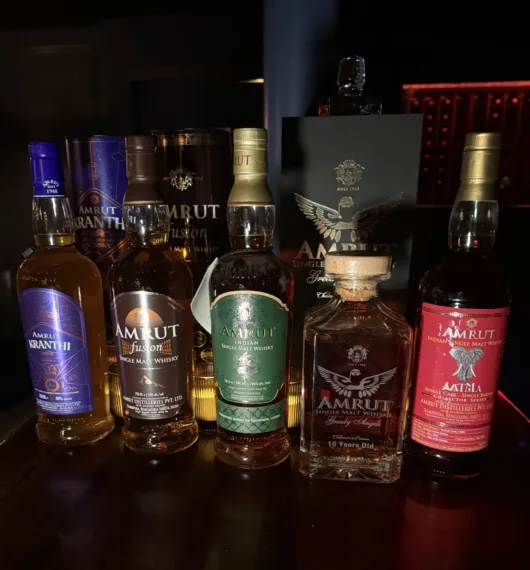
The intimate, speakeasy-style tasting room is dedicated to Indian single malt whisky, with an impressive collection of rare bottles, Amrut imagery, and educational displays celebrating the distillery’s history and craftsmanship.
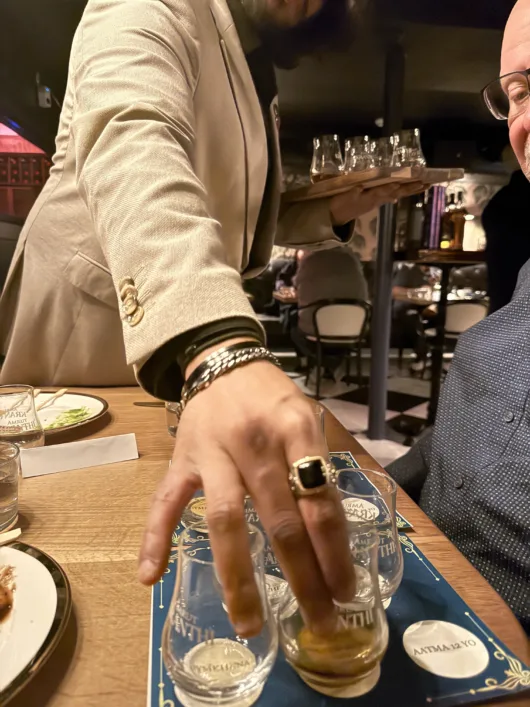
At a recent guided tasting, Amrut representative Neelesh introduced guests to the brand’s history, its distinctive approach to whisky-making, and several exceptional expressions that show why Indian single malts deserve a place alongside their Scottish counterparts.
A Whisky Collection Unlike Any Other in New Jersey
House of Amrut is the passion project of owner Satinder Sharma, a longtime admirer of the brand who spent about two years bringing the concept to life.
According to Neelesh, the Jersey City location houses the largest collection of Amrut whiskies in the United States, with approximately 27 different single malt expressions represented. Amrut’s broader portfolio includes more than 50 expressions, ranging from accessible everyday bottles to extraordinarily rare collector’s releases.
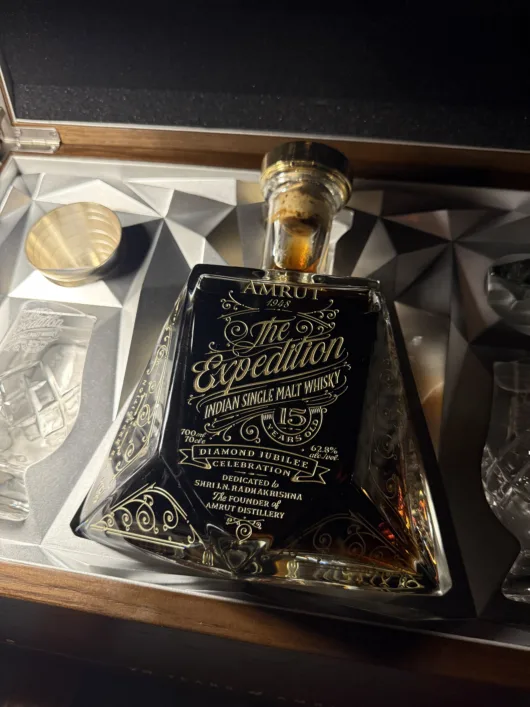
The collection spans a remarkable price range, beginning around $40 and climbing to $12,500 for the Amrut 1948 Expedition, 15 Year Old, one of the rarest bottles on display.
The distillery produced only 75 bottles of that release worldwide, with just 25 allocated to the United States.
For whisky collectors, that’s a serious find. For everyone else, it’s a fascinating glimpse into just how valuable a bottle of Indian single malt can become.
From Indian Rum to World-Class Single Malt Whisky
Although Amrut is now internationally recognized for its single malt whiskies, the company began its journey producing rum.
Founded in India in 1948, Amrut remains a third-generation, family-owned business. Today, its portfolio includes whisky, rum, gin, and other spirits, although not every product is exported to the United States.
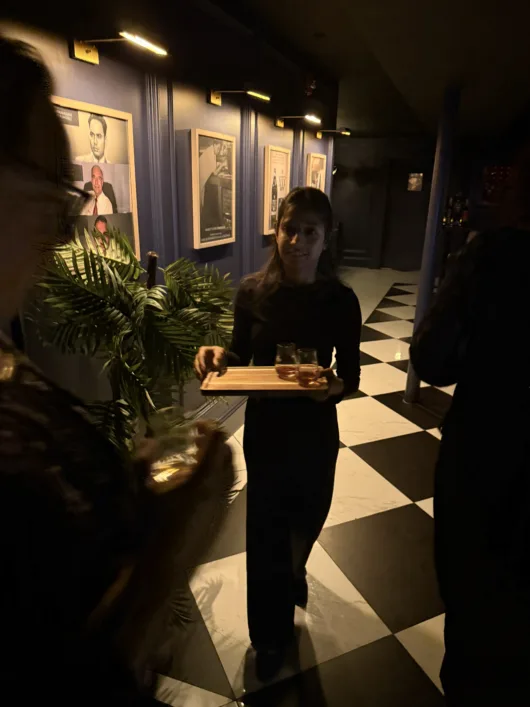
The tasting began with a welcome cocktail featuring Amrut Old Port Rum, a reminder that the company’s expertise extends well beyond whisky.
But it’s Amrut’s single malts, produced in Bengaluru, that have attracted an international following.
One of the most interesting distinctions is the grain itself. While traditional Scottish single malts generally use two-row barley, Amrut also works with Indian six-row barley, which has a different protein and starch composition.
According to Neelesh, that difference contributes to the bold, robust, and often tropical flavor characteristics associated with Amrut whiskies.
Why Indian Whisky Ages Differently
One of the most fascinating parts of the tasting had little to do with what was in our glasses and everything to do with where the whisky was made.
Bangalore’s warm climate creates dramatically different aging conditions than Scotland’s cooler environment.
Whisky matures in wooden barrels, and as temperatures fluctuate, the spirit moves in and out of the wood, extracting flavors and developing complexity. Bangalore’s warmer conditions accelerate that interaction.
There’s also the angel’s share, the charming industry term for the whisky that evaporates from barrels during aging.
In Scotland, that loss is typically relatively modest each year. In India, the warmer climate can cause much greater evaporation.
That makes producing older Indian whiskies particularly challenging. After a decade or more in the barrel, much of the original spirit may be gone.
The reward is a whisky that can develop intense flavor and character relatively quickly.
A Guided Tasting of Some Remarkable Whiskies
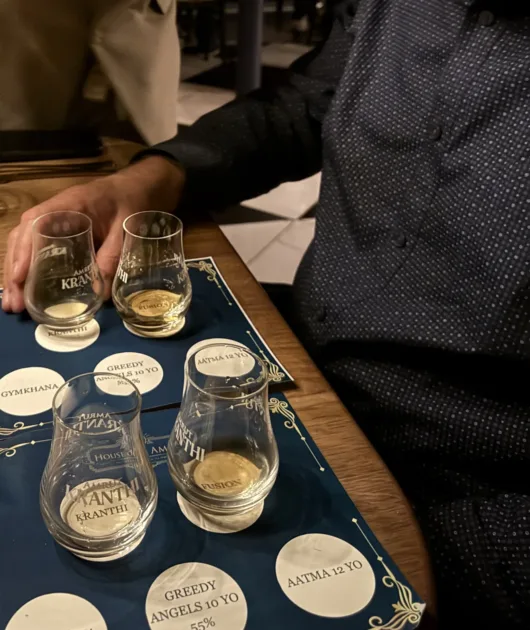
Among the expressions sampled was Amrut Fusion, one of the distillery’s best-known single malts.
Fusion combines Indian barley with peated Scottish barley, bringing together two whisky-making traditions in one bottle. The grains are distilled and matured separately, then combined for further maturation.
The result is a whisky with notes of dark chocolate, orange, citrus, and a restrained smokiness that doesn’t overwhelm the palate.
Neelesh also shared a simple tasting technique: cover the top of the whisky glass with your hand, gently warm it, then lift your hand to experience the concentrated aromas. It’s a way to explore the whisky’s character without adding water or ice right away.
The evening continued with several considerably rarer expressions.
One was a special single-cask bottling created for Gymkhana, the acclaimed London Indian restaurant. This high-proof release let guests taste something not typically available on American retail shelves.
Another highlight was Greedy Angels 10 Year Old, one of Amrut’s older and more limited whiskies. Its name references the significant evaporation that occurs during the lengthy aging process in India’s climate.
Guests also sampled an exceptionally limited 12-year-old single-cask whisky finished in a rum barrel. The cask yielded just 60 bottles, making it a release even dedicated whisky enthusiasts rarely encounter.
The tasting offered a fascinating progression from approachable expressions to highly specialized bottlings, each demonstrating a different aspect of Amrut’s approach to maturation, blending, and flavor.
A New Destination for Whisky Lovers in Jersey City
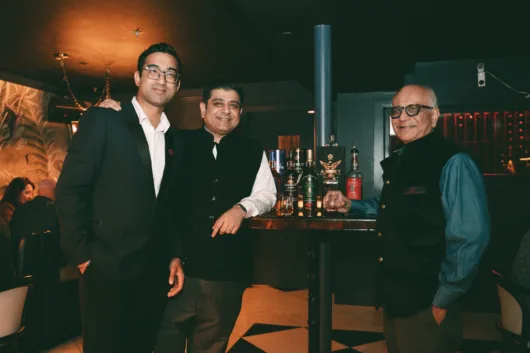
What makes House of Amrut particularly interesting isn’t simply the value of the bottles on display. It’s a chance to discover a whisky category many American consumers are only beginning to explore.
For years, conversations about premium single malt whisky have largely centered on Scotland, with Japan and the United States also earning considerable attention. Indian single malts are increasingly part of that conversation, and House of Amrut is bringing them into the spotlight in New Jersey.
Sharma’s dedication to assembling such an extensive collection lets whisky enthusiasts explore everything from Amrut’s signature releases to bottles that would be hard to find almost anywhere else in the country.
And while most visitors probably won’t order a pour from a $12,500 bottle, it still makes for an interesting conversation to know it’s there.
House of Amrut is a welcome addition to Jersey City’s evolving food and beverage scene, especially for anyone who wants to see what happens when Indian ingredients, climate, and generations of distilling expertise meet in a glass.
House of Amrut
136 Newark Avenue, Jersey City, NJ 07302